
What Cabinet Depth Really Solves, And What It Breaks
When homeowners ask about deeper cabinets, they are rarely asking about inches.
They are asking about friction.
“My base cabinets aren’t deep enough.”
“I have oversized woks.”
“Can I make the island deeper?”
“What’s the maximum depth allowed?”
These are not dimension questions. They are workflow questions disguised as storage problems.
The Standard - And Why It Exists
Typical base cabinet depth: 24 inches (610 mm). Typical island cabinet depth: 24 inches per side (before overhang)
This dimension exists for three reasons:
Ergonomics – Reach without strain.
Countertop compatibility – Standard slabs align cleanly.
Appliance integration – Ranges, dishwashers, and panel-ready appliances are calibrated to this depth.
You can increase depth. But every added inch changes more than storage capacity.
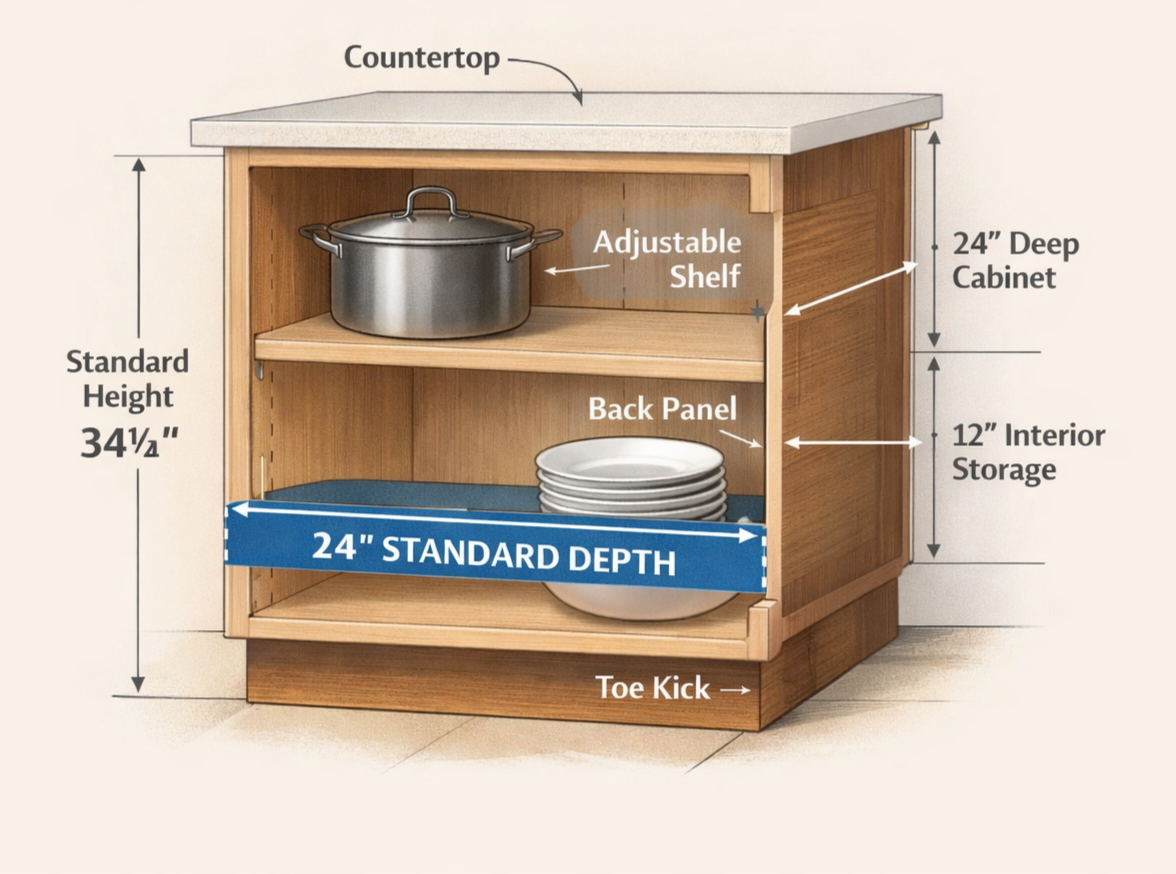
24 INCHES - THE DIMENSION MOST KITCHENS ARE BUILT AROUND
What Deeper Cabinets Actually Solve
1. Oversized Cookware
To store large woks, commercial stock pots, roasting trays efficiently. If you cook with scale, shallow drawers will fight you.
2. Bulk Storage Households
Families who cook daily, entertain frequently, or store ingredients in volume.
3. Accessibility Scenarios
Wheelchair users or seated prep situations may require modified reach zones and adjusted depths - but these require precise planning, not guesswork.
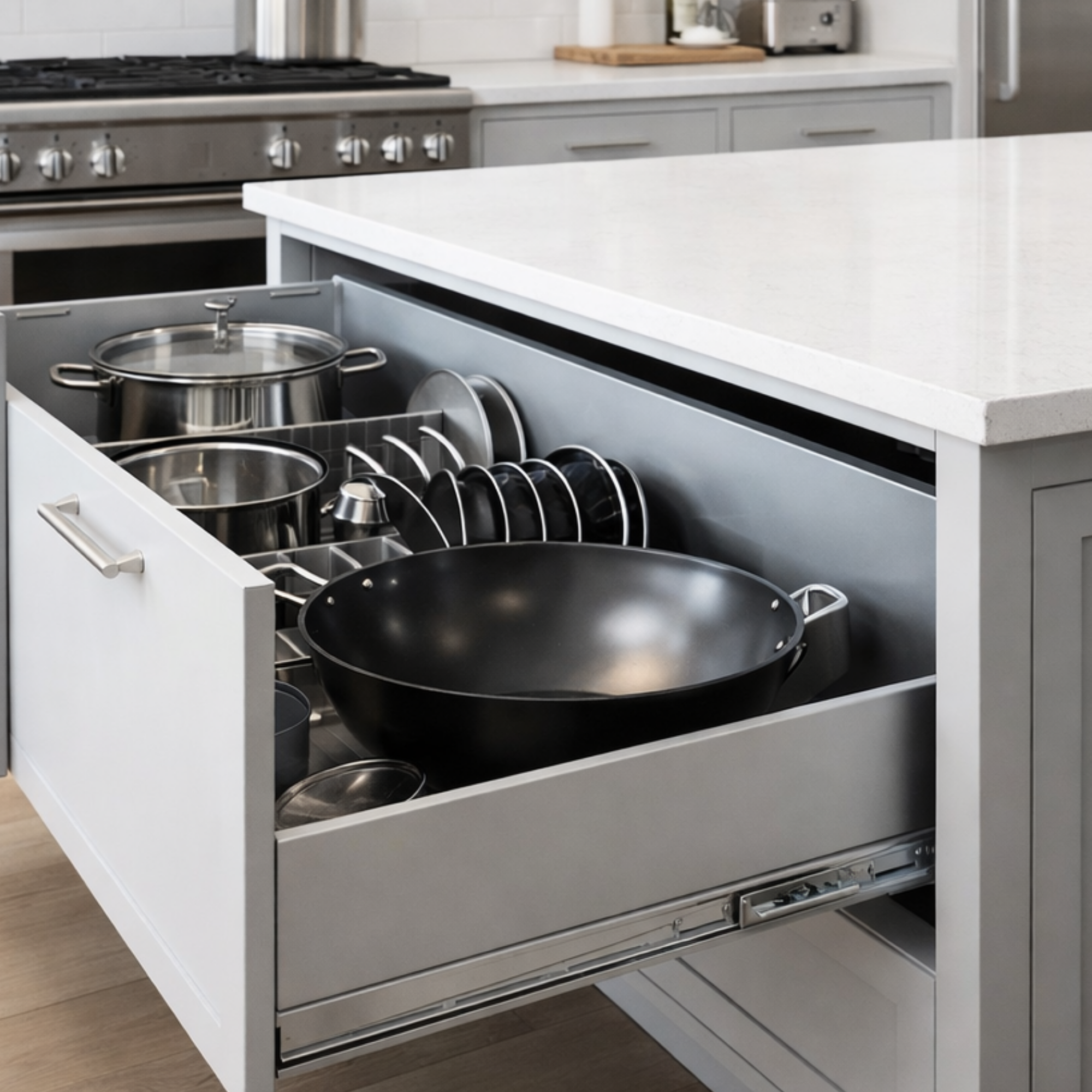
STORAGE ALIGNED WITH THE COOKING ZONE
What Deeper Cabinets Break
1. Reach Efficiency
Depth beyond 24–27 inches becomes a black hole. Items migrate to the back. You bend more. You forget what you own.
2. Walkway Clearance
Every inch added to an island reduces aisle width. Below 42–48 inches clearance, traffic and cooking collide.
3. Countertop Overhang Balance
Thicker islands require structural support planning. You are no longer in standard territory and you now move into customization.
4. Visual Mass
A 30-inch deep island reads heavy. Proportion shifts & the kitchen can feel compressed.
The Real Question: Where Should Pots & Pans Live?
Instead of - How deep should cabinets be? Questions should be:
Are they stored near the cooking surface?
Are they in deep drawers instead of doors?
Are dividers managing lids?
Is the storage within the primary cooking zone triangle?
In most kitchens, the optimal solution is: Deep drawer stacks (24” cabinet box) near the range.
Drawers outperform doors. Access matters more than raw depth. But then costs can be a factor.
So choices and decisions need to ne measured and evaluated!
When I Approve Extra Depth
I consider deeper cabinetry when:
The kitchen footprint is generous.
Aisle clearances remain compliant.
The client’s cookware truly demands it.
We design interior drawer organization intentionally.
The visual mass aligns with the architectural language.
Finally, the budget allows it and we are able to prioritize essentials!
Otherwise, increasing depth is a band-aid over poor planning.
Decision Rule
If you are increasing cabinet depth to “fit more,” pause.
First ask:
Are you storing the right items in the right zone?
Could drawer configuration solve this?
Is this a storage issue - or a layout issue?
Renovation success comes from sequencing decisions properly. Depth is a secondary adjustment - not a primary fix.
Final Thought
More depth does not equal more efficiency. It often equals more chaos, unless designed with intent. Cabinetry is not about maximum capacity. It is about minimum friction and maximum efficiency!