
Why Kitchen Finishes Must Be Chosen in Order, not taste!
Selecting Your Kitchen Finishes
Most kitchens don’t fall apart because of bad taste. They fall apart because finishes are chosen out of order.
A backsplash picked too early OR a countertop chosen in isolation, Hardware added as an afterthought - When that happens, even beautiful materials fight each other.
A finished kitchen only feels resolved when decisions are made in the right sequence.
Why Finish Selection Is a Design Process; Not a Shopping Exercise
Every kitchen reaches its final, cohesive look only after finishes are selected deliberately and in relationship to one another.
That requires:
material judgment
restraint
and an understanding of hierarchy
You cannot build a kitchen one item at a time without a reference point. And you cannot rely on individual samples - tile here, pull there, counter later, and expect clarity to emerge on its own.
It doesn’t.
A Real Client Scenario (What Usually Goes Wrong)
The mood board shown here was created for an online design client who came to me already overwhelmed.
The following was what she had:
a few items ordered
a general “farmhouse” direction
and growing uncertainty about everything else
Nothing felt wrong individually, but nothing felt right together. So we stopped shopping and reset the process. Instead of adding more options, we Re-sequenced The Decisions.
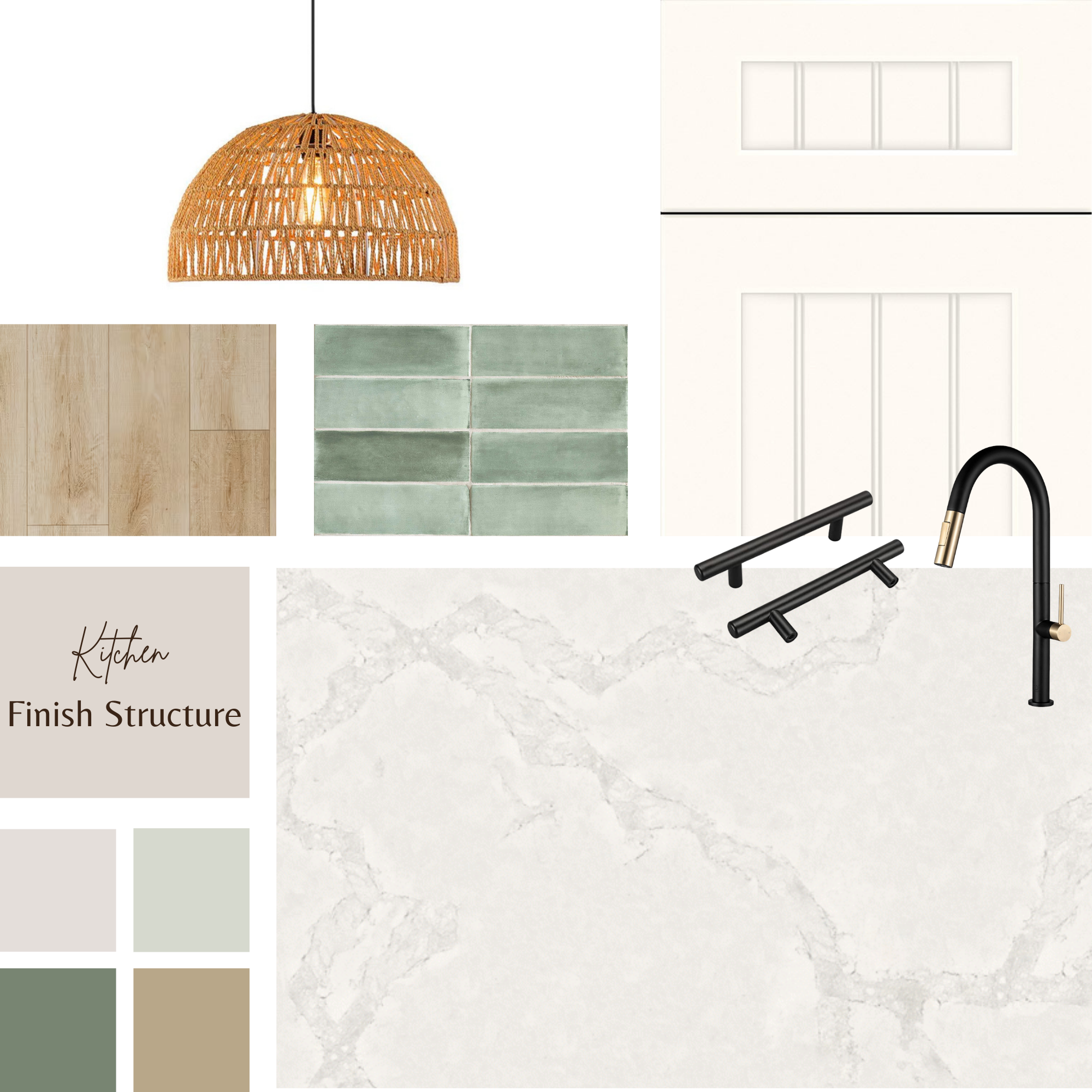
The Correct Order for Choosing Kitchen Finishes
This is where most homeowners go off track, so this matters.
1. Cabinet Door Style Comes First
Cabinetry sets the architectural language of the kitchen.
Door profile, construction, and proportion determine:
how expressive or restrained finishes can be
how much visual weight the space can carry
Until this is resolved, everything else is premature.
2. Cabinet Finish Is the Anchor
Paint, stain, or a hybrid finish is the largest visual surface in the room.
This choice controls:
undertones
contrast levels
and how calm or busy the kitchen will feel
This is not a trend decision. It’s a discipline decision.
3. Countertops Stabilize the Scheme
Countertops are not meant to be the star.
Their role is to:
ground the palette
absorb visual movement
and create continuity
If a countertop has to “carry” the kitchen, something earlier wasn’t resolved.
4. Backsplash Supports—It Does Not Lead
This is where most people start. And it’s where problems begin.
A backsplash should respond to:
cabinet style
cabinet finish
and countertop tone
It adds rhythm and texture, not dominance.
5. Hardware, Fixtures & Accents Come Last
These are the only elements allowed to express personality.
When everything before them is clear, hardware and fixtures feel intentional, not decorative noise.
Why Mood Boards Matter (When Used Properly)
This board was not created for inspiration. It was created for decision testing.
A proper mood board:
reveals clashes early
forces hierarchy
removes excess options
It’s not about adding more ideas. It’s about eliminating the wrong ones.
A good board prevents regret. A bad one creates it.
The Real Reason Finish Selection Feels Overwhelming
It’s not the number of options. It’s the lack of order.
When finishes are chosen emotionally or independently, doubt creeps in. When they’re chosen in sequence, the kitchen starts to feel inevitable. It does NOT have to be styled, NOR decorated NOR Resolved!