
Enhancing Function Through Renovation: 12 Structural Shifts
Enhancing functionality through renovation is not about adding features.
It is about restructuring how a home supports behavior.
The following 12 shifts represent the structural areas where function either improves or deteriorates during renovation.
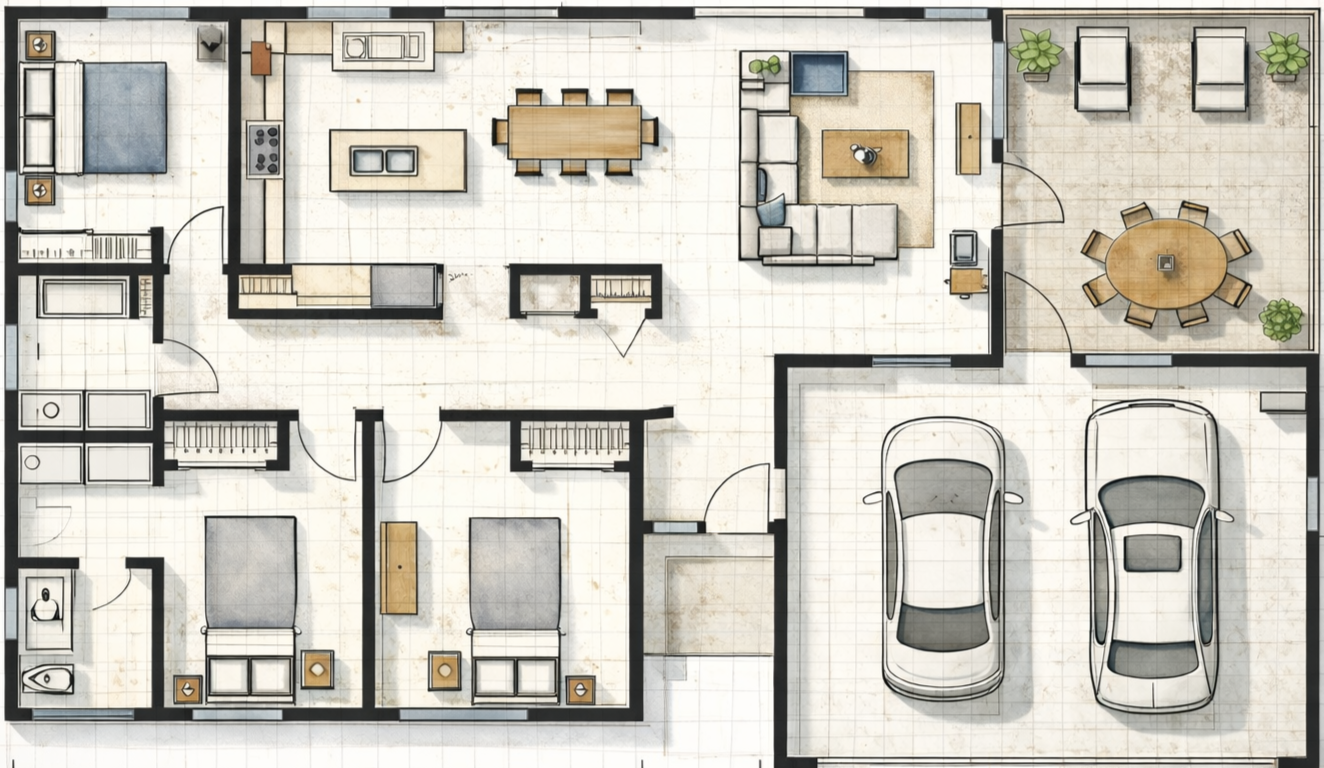
1. Clarifying Behavioral Patterns
Renovation improves function only when it begins with how people actually live, not how spaces are marketed.
What determines spatial requirements?
➡️Routines
➡️Frequency of use,
➡️Timing, and
➡️Movement patterns
Without behavioral clarity, layouts become theoretical instead of operational.
2. Correcting Circulation and Adjacency
Function improves when rooms relate logically to one another.
Task distances shorten, cross-traffic disappears, and pathways remain unobstructed.
Circulation is not decorative
It is structural efficiency in motion.
3. Redefining the Kitchen as Infrastructure
The kitchen operates as a coordination hub rather than a showcase.
What determines its performance are:
Workflow sequencing
Storage proximity &
Zoning
Surface upgrades cannot compensate for poor structural planning.
4. Designing Bathrooms for Movement Efficiency
Bathrooms expose inefficiencies quickly because clearances are tight and tasks are sequential.
Lighting, ventilation, storage, and fixture placement must operate as a system.
Precision matters more than ornament.
5. Aligning Storage with Habit
Storage is behavioral infrastructure. It should reflect frequency and ritual, not just volume.
When storage mirrors actual use patterns, friction declines and maintenance improves.
6. Designing for Work as a Permanent Condition
Work now occupies fixed territory within the home.
Acoustic control, ergonomic stability, and visual boundaries are no longer optional.
Renovation must treat work as infrastructure, not temporary accommodation.
7. Building Flexibility into Multi-Purpose Spaces
Rooms must adapt without devolving into clutter. Movable furniture alone does not create adaptability.
To enables controlled flexibility what is needed are:
➡️Structural planning
➡️Electrical positioning
➡️Lighting zones
➡️Wall reinforcement
8. Extending Function into Outdoor Living
Without integration, outdoor space remains occasional rather than operational.
Outdoor areas become functional extensions when transitions, weather control, and adjacency are resolved. Threshold design, coverage, and lighting determine usability.
9. Integrating Technology with Restraint
Technology enhances function only when it reduces cognitive load.
Systems should simplify control and consolidate decisions. Over-layered automation introduces complexity rather than clarity.
10. Stabilizing Environmental Performance
Energy efficiency is ultimately about predictability.
What can reduce daily adjustment?
➡️Temperature stability,
➡️Airflow management, and
➡️System reliability
Comfort is measured in consistency, not novelty.
11. Designing for Accessibility and Longevity
Clearances, transitions, and adaptable elements allow a home to remain viable over time.
Functional renovation anticipates mobility changes before they become urgent.
Longevity is strategic, not reactive.
12. Preserving Identity While Updating Performance
Architectural details, heirlooms, and spatial memory anchor identity.
Renovation must improve performance without erasing narrative.
Function and meaning are not opposites, they must be calibrated together.
Each of these shifts warrants deeper examination. Function is not a checklist, it is the result of aligned decisions.
Continue the Conversation
If you value structured renovation thinking, my newsletter explores the behavioral and strategic side of design decisions.