
An Introduction to Design Conversations
A design conversation is not a discussion about finishes. It is an inquiry into how people live. Yet most projects begin elsewhere!
They begin with inspiration images, with questions about style preferences, with early decisions about cabinetry colors and tile selections. These elements are not irrelevant - but they are not primary.
Design rarely fails because of taste. It fails because of sequencing.
A meaningful design conversation does not start with what a space should look like. It starts with what a space must support.
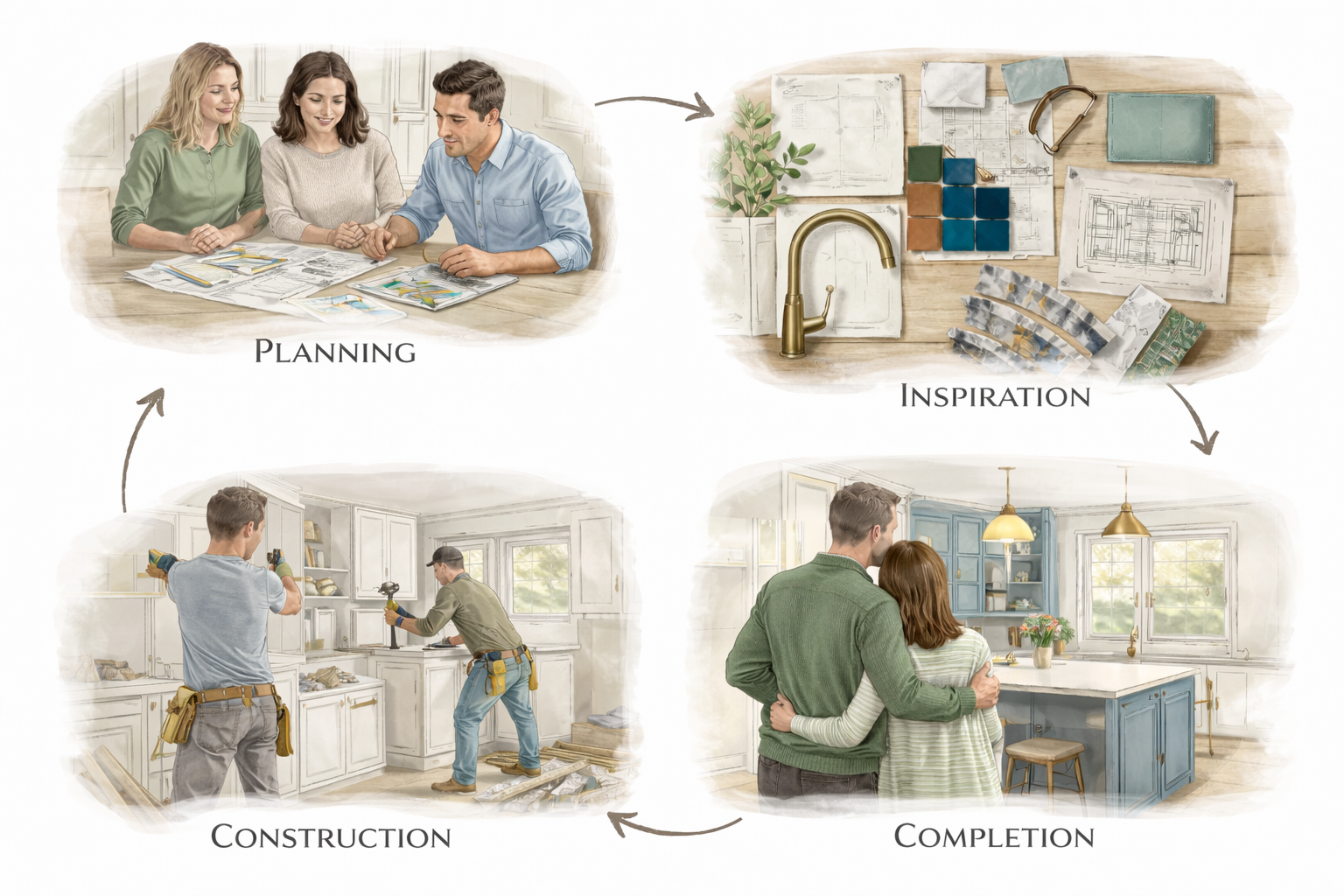
The First Introduction: Reading the Existing Space
The first introduction to a space is observation.
When I enter a home, I am not evaluating décor. I am reading behavior.
Where do shoes accumulate? Which chair is consistently occupied? What surface functions as the daily drop zone? Which pathway feels constricted?
Homes reveal patterns long before they reveal preferences.
A dining table doubling as a workstation. An island is overloaded because it serves as storage, prep zone, homework desk, and mail center. A hallway narrowed by overflow of shoes, grocery bags, umbrellas, jackets.
These are not aesthetic flaws. They are indicators of spatial pressure.
The existing condition is data. The design conversation begins by interpreting it.
Starting With the Day - How does life begin?
One of the most clarifying prompts in any consultation is simple: “Walk me through your morning.”
From that single question, priorities surface quickly:
Who wakes first? Who shares a bathroom?
Is breakfast cooked or assembled? Are lunches packed?
Where do bags and devices land? Who needs quiet and who needs movement?
Morning routines expose friction. Friction reveals where design must intervene.
➡️If three people converge at the same narrow corridor at 8:10 a.m., the issue is circulation.
➡️If the coffee station blocks prep space daily, the issue is zoning.
Design must respond to tempo, not trend.
Habits Before Style
A well-designed home reflects behavioral truth, not aspirational imagery OR stylish endeavors!
The design conversation clarifies whether meals are shared daily or sporadic, whether cooking is collaborative or solitary, whether entertaining is central or occasional. It examines whether someone works from home permanently, and how independent children are in their routines.
Habits determine adjacency:
➡️If children prepare their own breakfasts, pantry access must be intuitive and reachable.
➡️If entertaining is frequent, circulation between kitchen and living areas must remain unobstructed.
➡️If cooking and cleanup happen simultaneously, task zones must allow parallel function.
Layout emerges from daily use patterns. Style is layered afterward on top one layout is assigned.
Frequency, Duration, Complexity
Every space has primary and secondary users.
A powder room used daily by family operates differently than one reserved for guests. A kitchen designed for elaborate weekend cooking requires different infrastructure than one centered on efficient weekday meals.
The design conversation clarifies three core variables:
Frequency of use
Duration of tasks
Complexity of activity
Without this clarity, layouts become theoretical.
A baking enthusiast requires surface depth and vertical tray storage; A household that rarely cooks does not.
Precision and honest decision protects both function and budget.
Mapping Life Into the Design
Once behavior is clear, the conversation becomes Structural & Clear
We examine movement paths, task clusters, storage pressure points, and lighting deficiencies. These are not stylistic decisions; they are operational realities. They are existing problems that are destined to be Solved By Design
➡️Walls move because pathways collide.
➡️Cabinetry shifts because task distances are inefficient.
➡️Lighting relocates because routines demand visibility at specific hours.
Design decisions should be spatial corrections, not aesthetic impulses.
Focusing On the Space Itself
Once routine and flow for the space are defined do we narrow the lens.
In a kitchen, the discussion becomes specific to prep zones, cooking zones, cleaning sequences, storage hierarchy, and appliance placement logic.
In a bathroom, it addresses morning traffic, privacy layers, moisture management, and lighting stratification.
In living areas, it considers orientation, sightlines, furniture scale, and acoustic impact.
Detail gains precision because the foundation is the priority
Aesthetics in Proper Order
Keeping in mind that Material Finishes matter, creation of Atmosphere matter, Color & Decor for the space matters - But they are later Refinements!
When design begins with aesthetics, function gets sacrificed. When design begins with life, the new space works towards improving that life!
The order in Design Evaluation is to start from the most required element:
Behavior
Movement
Function
Spatial correction
Detail
Finish
Once this order is reversed, proper design planning is hindered!
Design as Interpretation
A true design conversation is diagnostic. Its almost like we Designers are actually Home Design Doctors!
The Design Conversation is listening before proposing. It is clarifying before sketching. It reducing friction before presenting options.
Homes are not empty shells awaiting decoration. They are active systems shaped by routines, memory, and habit.
Design is not the imposition of style. It is the interpretation of life into space.
Closing
The first introduction to a space is not about what it looks like. It is about what it supports and what happens.
When the design conversation begins with how the day unfolds, how movement patterns intersect, and who truly uses the space, the outcome is durable and long lasting.
Spaces should not require adaptation from their occupants. They need changes anticipating the action of their occupants.
AND - This is where Real Design Conversations begin.
You May Also Like
The Spaces We Build Are the Stories We Live →
Why Interior Design Needs Better Storytellers →