
The Indian Kitchen, the Canadian Home, and the Journey in Between
The Indian kitchen I grew up with was never quiet.
It was not quiet not because of noise, but because of human presence, whether it was my Mom or the neighbor aunty. There was always sounds that emanated, sounds of talking, cooking, the whistle of the pressure cooker or the the sizzle of “tarka” in oil in the “kadai”!
Someone was always there. Cooking. Watching. Waiting. Preparing. Cleaning. Remembering.
It was a room of continuity. It was the hub of constant activity. It was the room for early morning rituals and late night coffee and the last lingering meal!
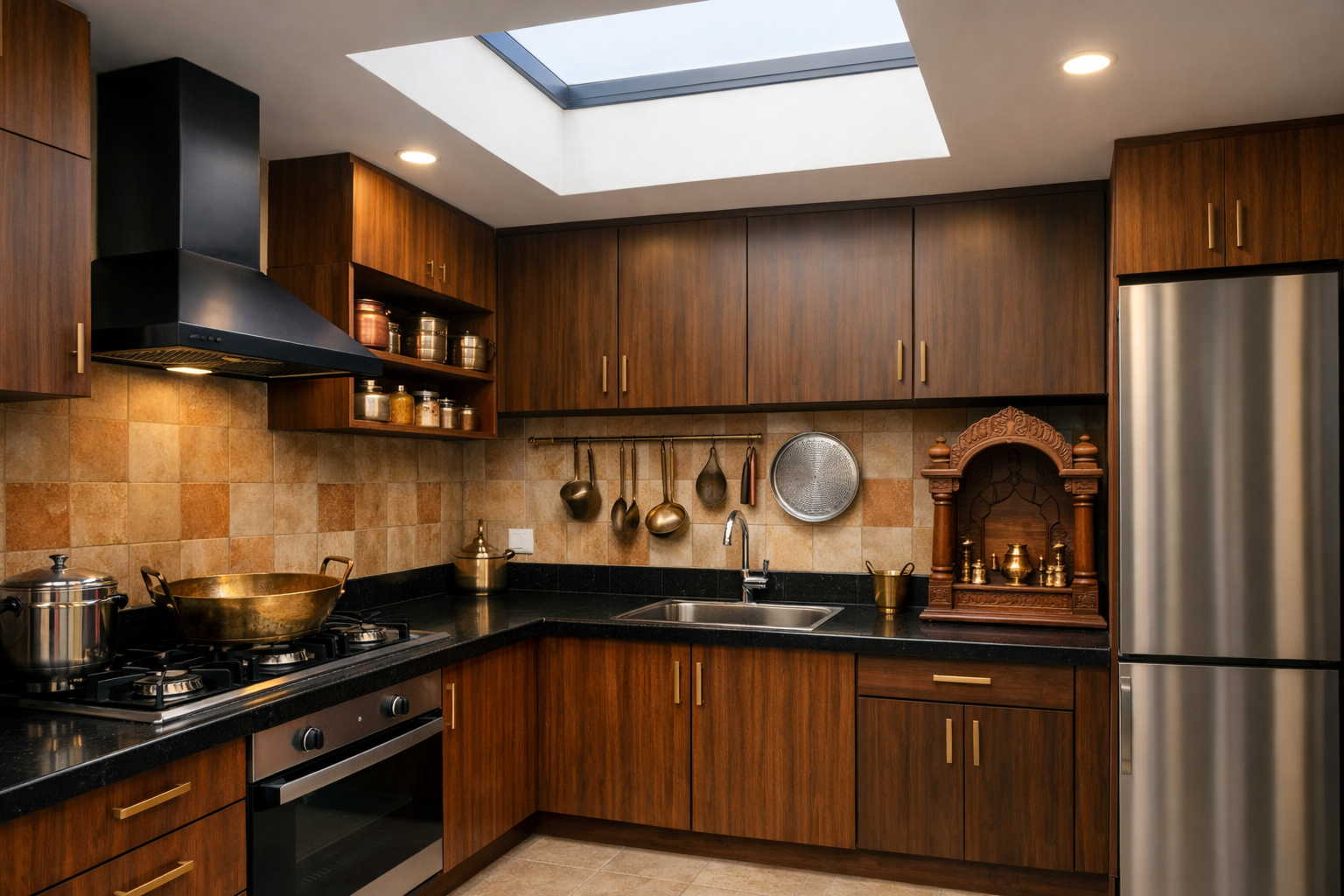
The Kitchen was an arm of our lives that was always extended.
The kitchen was not isolated from the rest of the home. It was a social organism. Movement through it carried hierarchy, ritual, and rhythm. Spices were not decor. They were stored memory. Utensils were not aesthetic objects. They were generational tools.
A space for grandmother’s recipes and the sweet smell of chai with cardamom! A space for festival cooking that fed the entire neighborhood! A space where smell of freshly boiled milk and incense mingled to give a nostalgia that measured up to no amount of experiences. Stories were woven every minute. Love existed in the simple round of the roti. The kitchen space encoded values.
When Kitchens move to create a new story, shift culture and adapt.
The Canadian homes I later inhabited told a different story, a story that I wove with elements of my childhood cherished memories.
Kitchens became open style, Islands expanded, Appliances aligned in sleek rows. Surfaces simplified. The aesthetic became minimal. The expectation shifted toward efficiency, independence, and flow.
And as our lives moved on and the consecutive homes we owned, we imbibed our kitchens with subtle cultural significance mingled with Western style. Thereafter where functional spaces existed it became attention to detail, where style evolved we brought in subtle movement. Our Canadian homes changed with our family lifestyle, influenced by children’s experiences, familial acquaintances and elements we each brought in through our learning of new methods of living.
Both spaces functioned.
But they functioned differently because they carried different cultural assumptions.
In the Indian kitchen:
Proximity meant care.
Heat meant nourishment.
Shared work meant belonging.
In the Canadian kitchen:
Efficiency meant autonomy.
Clean lines meant order.
Open sightlines meant transparency.
Migration is not only geographic. It is spatial experiences enriched with our new needs.
When we move between cultures, we do not simply adjust language or climate. We renegotiate how space organizes daily life. We adapt our habits. We compromise on ritual. We reinterpret memory through new layouts.
The journey between kitchens is the journey between values.
And often, renovation becomes the place where those values meet.
How much openness feels expansive - and how much feels exposed?
How much minimalism feels calm - and how much feels empty?
Where do tradition and modernity coexist without erasing one another?
Design does not erase origin. It reveals it and enriches with new outlook!
Every kitchen carries its cultural inheritance - whether visible or not.
You may also like
The Spaces We Build Are the Stories We Live →
Homes, Loss, and the Spaces We Return To →